Forgiven

Introduction
Steam remains the dominant PC storefront, yet indie developers often struggle to attract consistent visitors without understanding where their traffic actually originates. I’ve found that the strongest launches combine algorithmic Steam features with external channels like content creators, wishlisting campaigns, and community-driven referrals to build compounding visibility.
Key Takeaways
- The Steam Discovery Queue drives a significant share of impressions for new indie titles.
- Wishlist momentum directly influences Popular Upcoming placement before launch day.
- Content creators and streamers deliver the highest conversion rates among external sources.
- Steam festivals and demos can multiply store page visits by up to seven times.
- Cross-promotion through developer bundles unlocks stable, low-cost traffic long-term.
Understanding Steam Traffic Sources for Indie Developers
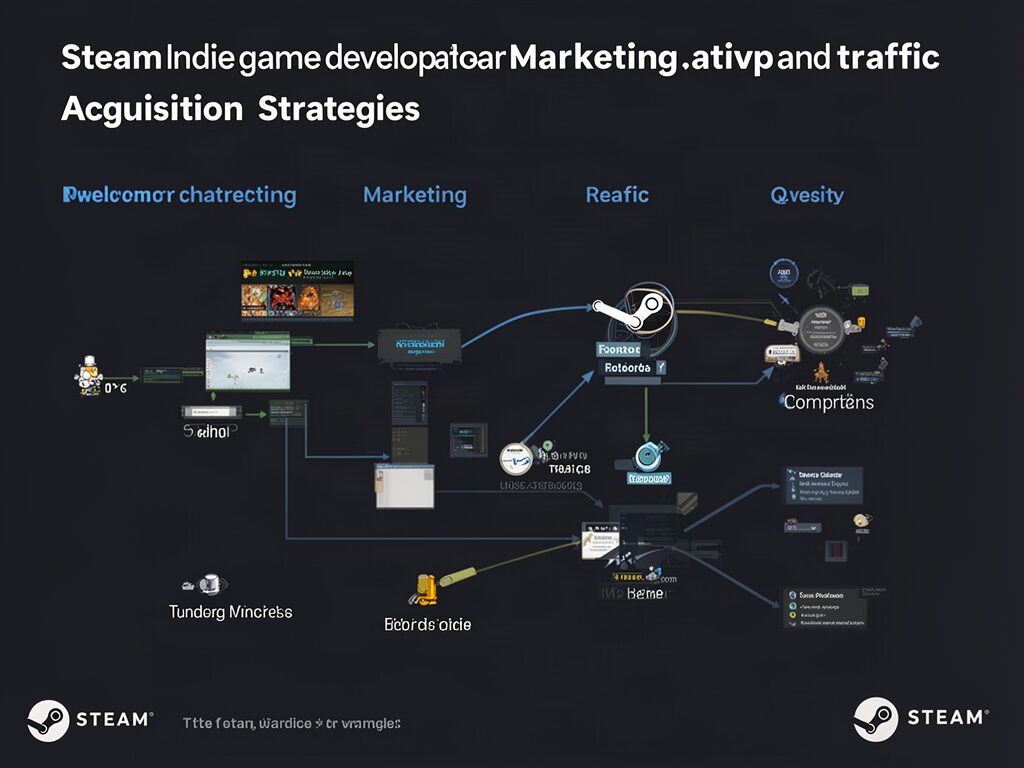
Steam traffic sources are the channels that push players to a game’s store page, and each behaves differently in terms of volume and conversion. I split them into two clear groups: internal Steam traffic, driven by the platform’s algorithm, and external traffic, driven by marketing, press, and creators. Both matter, but the balance shifts depending on your game’s stage.
According to Valve’s own UX Summit talks, roughly 50% of purchases originate from Steam’s on-platform features. Therefore, ignoring internal placement is one of the costliest mistakes an indie can make. However, external traffic often triggers the algorithmic boosts that unlock those internal placements in the first place.
Internal Steam Traffic Sources That Move the Needle
Steam’s internal ecosystem is where most conversions actually happen, and it’s tuned to reward games with strong early signals. For example, the Discovery Queue alone surfaces titles to millions of users daily based on tags, wishlists, and browsing behaviour. Moreover, Popular Upcoming and New & Trending sections can each deliver five-figure visit counts within hours.
Here are the internal sources I prioritise for every launch:
- Discovery Queue — personalised recommendations based on tags and player history.
- Popular Upcoming — pre-launch visibility driven by wishlist velocity.
- New & Trending — post-launch chart based on revenue and player activity.
- More Like This — appears on similar games’ store pages.
- Steam Front Page Banners — reserved for high-momentum releases.
- Tag-Based Browsing — long-tail source that compounds over time.
- Steam Search — direct intent traffic, often the highest-converting channel.
To improve placement, I recommend reviewing my guide on how to boost Steam algorithm signals, which explains the exact metrics Valve weighs. Consequently, tuning these signals early makes internal traffic snowball naturally.
Steam Festivals, Demos, and Curated Events
Steam festivals have become one of the strongest visibility drivers for indies since 2021. For instance, participation in Steam Next Fest regularly produces 5,000 to 40,000 new wishlists for well-prepared titles. Additionally, themed sales like the Endless Replayability Fest or Cozy Games Fest expose niche titles to hyper-targeted audiences.
I always plan a demo release around a festival to maximise concurrent player numbers. Furthermore, high demo engagement feeds directly into algorithmic boosts, which then trigger secondary discovery placements. If you want practical tactics, my write-up on how to increase Steam discovery traffic covers the timing patterns I use.
External Traffic Sources Every Indie Should Prioritise
External traffic often decides whether a launch trends or fades within 48 hours. Therefore, I treat external channels as the ignition system for Steam’s internal algorithm. Each source below has a distinct role, and the best campaigns stack several simultaneously.
The external sources I consistently rely on include:
- YouTube creators — long-form previews and Let’s Plays convert exceptionally well.
- Twitch streamers — live demos generate real-time wishlist spikes.
- TikTok short-form video — currently the highest ROI channel for visual games.
- Reddit communities — niche subreddits deliver highly targeted clicks.
- Press coverage — outlets like Rock Paper Shotgun and PC Gamer still move meaningful traffic.
- Discord servers — genre-specific communities produce loyal early adopters.
- Newsletter features — curated lists such as Wholesome Games drive concentrated bursts.
Moreover, tracking UTM parameters through Steam’s partner backend reveals which creators actually convert. For example, I’ve seen a single 10,000-view YouTube video outperform a 200,000-view stream simply due to audience alignment.
Wishlist Campaigns and Cross-Promotion Tactics
Wishlists are the currency of Steam success, and they directly influence launch-day algorithm placement. Furthermore, games entering release with 10,000 or more wishlists typically hit New & Trending within hours. I therefore treat wishlist growth as the primary KPI throughout the entire pre-launch period.
Cross-promotion with other developers is a criminally underused tactic. For instance, sharing capsule swaps, joining developer bundles, and participating in Steam events collectively can add thousands of impressions weekly at zero cost. Additionally, my guide on how to reach the Steam trending tab fast breaks down the exact wishlist thresholds required.
Measuring and Optimising Your Traffic Mix
Steam’s UTM tracking system, accessible through the partner dashboard, is the tool I use for every campaign. Consequently, I can attribute wishlists and sales to specific creators, ads, or posts with reasonable accuracy. Additionally, monitoring the visit-to-wishlist conversion rate reveals whether your store page needs work or whether the traffic quality is poor.
Benchmarks I aim for include a visit-to-wishlist rate above 10% and a wishlist-to-purchase rate around 15–20% in the first week. Moreover, low conversion from external sources usually indicates a mismatch between messaging and audience. Therefore, I A/B test capsule art, trailers, and short descriptions constantly.
Conclusion
Steam traffic isn’t a single channel — it’s a layered system where internal and external sources amplify each other. I’ve found that indies who invest early in wishlists, festivals, creator outreach, and algorithm signals consistently outperform those relying on a single tactic. Ultimately, the developers who treat traffic acquisition as an ongoing discipline, rather than a launch-week sprint, are the ones who build sustainable careers on the platform.
Sources:
GDC Physics Best Practices Framework
Bethesda’s Starfield